Finding your home address, phone number, relatives, and age on a people-search site feels like a single website problem. It is not. The listing is usually one copy inside a larger supply chain built from public records, commercial files, social profiles, and data exchanged among brokers.
A useful purge does not promise to erase you from the internet. It reduces the information a stranger can find quickly, documents what was removed, and creates a maintenance cycle for data that returns. That makes the project measurable instead of endless.
The right approach depends on your risk, available time, and state. A person facing stalking or doxxing needs a different order of operations than someone doing routine household privacy maintenance. This playbook gives you both paths.
The Decision in One Minute
Choose the path that matches your situation
- You have a current safety threat: preserve evidence, remove the most dangerous current-address and phone listings first, and use the urgent-safety steps below. Do not wait for a broad quarterly sweep.
- You can give this project one focused hour: run the manual first pass. It gives you direct control and creates a baseline that any paid service can later be measured against.
- You live in California: submit a free DROP request now, then address the highest-risk visible listings while the state process moves forward.
- You cannot maintain the work: use a reputable paid removal service, but audit its dashboard and supplement gaps. A subscription is maintenance assistance, not a guarantee of disappearance.
If you want a broker-by-broker checklist while you work, open the Data Broker Opt-Out Guide in another tab. This article explains the strategy, order, evidence, and decision points behind that checklist.
What the Evidence Actually Shows
People-search sites can assemble profiles from property records, court records, voter files where available, social networks, other brokers, and commercial sources. The Federal Trade Commission warns that opting out of a people-search site does not remove the underlying public record, information held by relatives, or copies already collected elsewhere. The same information may later reappear. That is why the FTC treats removal as a repeated privacy task rather than a one-time delete button. See the FTC guidance on people-search sites.
A Consumer Reports evaluation followed thirty-two volunteers across thirteen people-search sites and seven paid removal services. After four months, the services had removed thirty-five percent of the exposed information they were assigned. The smaller manual opt-out group achieved about seventy percent removal. The study does not prove that manual work will always beat every service, but it does show that payment is not proof of complete coverage. Read the Consumer Reports Data Defense study.
The ecosystem is also much larger than the familiar people-search brands. Privacy Rights Clearinghouse says its unified database contains more than seven hundred fifty brokers, while California's official registry and deletion system cover hundreds of active registered brokers. No household can reasonably chase every company with equal urgency. The practical answer is risk-based triage, supported by the Privacy Rights Clearinghouse broker database.
Build a Risk-First Exposure List
Do not begin by collecting the longest possible list. Begin by ranking what could cause the most harm. Score each visible profile across four questions:
- Searchability: Does the result appear on the first page when someone searches your name, phone number, email address, or current city?
- Sensitivity: Does it expose a current home address, direct phone number, personal email, household member, school, employer, or date of birth?
- Linkage: Does the profile connect separate facts that would otherwise be difficult to associate, such as a relative, address, and workplace?
- Freshness: Is the information current enough to help someone contact, locate, impersonate, or answer identity-verification questions about you?
Remove current and highly searchable information first. Old addresses and stale phone numbers matter, but they belong behind current home, family, school, and work exposure. A risk-first list prevents the project from being consumed by low-value removals while the most useful targeting data remains public.
Search your full name with your current city, previous city, common name variations, phone number, email address, and street name. A private browser window can reduce personalization in the results, but it does not make the search anonymous. Do not sign up for a broker's paid report merely to confirm that a profile exists.
Your One-Hour First Pass
Minutes zero through ten: establish the baseline
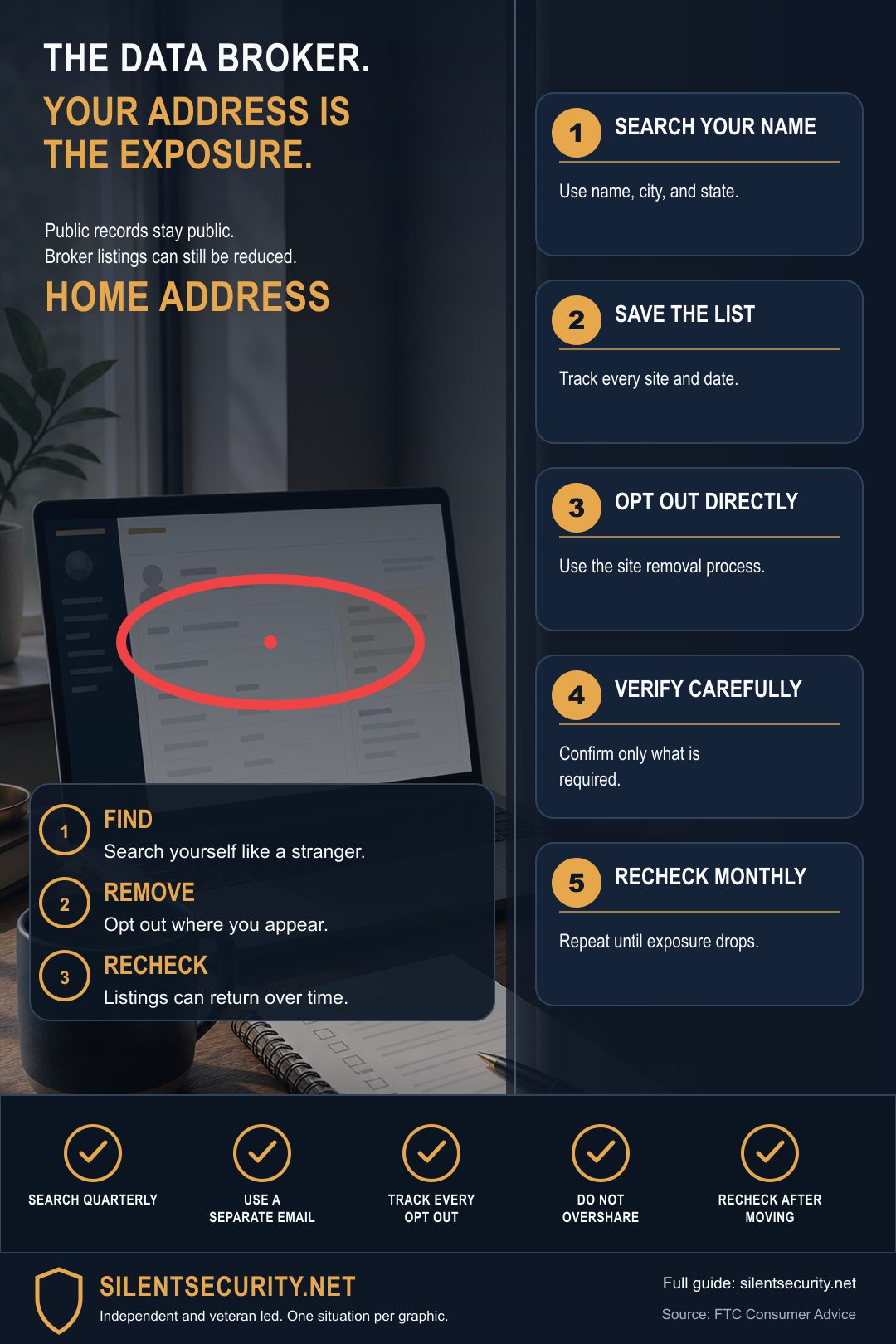
Run the searches above and save only the profiles that expose meaningful information. Capture the result URL and a screenshot that does not reproduce more personal data than necessary. Record the search term that found it. That gives you a repeatable test for the verification pass.
Minutes ten through twenty: create the removal log
Use a spreadsheet, encrypted note, or password-manager record with these fields: broker name, profile URL, information exposed, risk priority, official opt-out URL, date submitted, confirmation method, request identifier, promised processing time, verification date, result, and recurrence date. Use a dedicated privacy email so confirmations do not expose your primary inbox.
Minutes twenty through forty-five: remove the highest-risk profiles
Navigate from the broker's own privacy or opt-out page, not an advertisement. Submit only the information needed to identify the listing. If identity documentation is requested, confirm the domain, read the broker's published instructions, redact fields that are not required, and stop if the destination or purpose is unclear. The removal process should not create a more sensitive record than the one you are trying to suppress.
Minutes forty-five through fifty-five: reduce search visibility
Google's Results About You can find search results containing your phone number, home address, or email address and let you request removal from Google Search. Removing a search result does not remove the source page, so submit the broker opt-out as well. Follow the official Google Results About You instructions.
Minutes fifty-five through sixty: schedule verification
Set the first recheck for thirty days. Use the same search terms and inspect the source URL as well as Google. Mark each item removed, partially removed, still visible, or returned under a new URL. A submitted form is not a successful removal until the public result changes.
Use the Free Government Paths
California residents can use the state's Delete Request and Opt-out Platform, known as DROP, to send one free deletion request to more than six hundred active registered data brokers. The system launched on January 1, 2026, and brokers begin processing requests on August 1, 2026. Participating brokers must check for requests at least every forty-five days, while status updates may take as long as ninety days. The official July update reported more than three hundred twenty-five thousand consumer signups. Submit and track a request through California's official DROP portal.
DROP is broad, but it is not a reason to leave an urgent current-address listing untouched while waiting for statewide processing. Use it as a coverage layer and continue direct removal for the profiles at the top of your risk list.
For prescreened credit and insurance offers, use OptOutPrescreen.com, the official service provided by the major consumer credit reporting companies. The electronic option supports a five-year opt-out, while a permanent election requires a signed form by mail. This does not remove people-search profiles, but it reduces another commercial use of your credit-file data.
Manual Removal or a Paid Service?
| Path | Best for | Strength | Limit |
|---|---|---|---|
| Manual opt-outs | Focused first pass and high-risk listings | Free, direct, and easy to verify | Time-intensive and easy to neglect |
| California DROP | California residents seeking broad registered-broker coverage | One free state-managed request | State eligibility and processing time |
| Paid removal service | Households without time for recurring maintenance | Recurring scans, requests, and a central dashboard | Coverage varies and removal is incomplete |
Before paying, compare the actual broker list, rescan frequency, evidence of completed removals, household coverage, cancellation terms, privacy policy, and refund rules. Ask whether the service reports a submitted request or a verified disappearance. The Consumer Reports results above are a warning against judging a service by the size of its marketing list alone.
Verify the Result, Not the Submission
Your removal log is the control system. A useful scorecard tracks four outcomes: the number of high-risk profiles still visible, whether the current home address is searchable, the median time from request to verified removal, and the number of listings that reappear. Those measures tell you whether your process is working and whether a subscription is saving meaningful labor.
At the thirty-day check, repeat the baseline searches and revisit every recorded profile URL. If a listing remains, follow the broker's escalation path and retain the original confirmation. If the profile disappears but the search result remains, request a Google refresh or removal. If it returns under a new URL, treat that as recurrence rather than a new first-time discovery.
After the first verification, recheck quarterly and after a move, phone-number change, property purchase, new business filing, marriage, divorce, or other event that can refresh public and commercial records. Keep the privacy email active because brokers may send later confirmation or re-verification notices.
What Removal Cannot Do
- It cannot erase source public records. Property, court, licensing, and business records may remain available through the government body that created them.
- It cannot retrieve copies already sold. A successful opt-out changes future visibility or use; it does not pull data back from every prior buyer.
- It cannot remove information from another person's profile. Your address or phone number may still appear through a relative, roommate, former spouse, or business associate.
- It cannot replace account security. Credit freezes, unique passwords, multifactor authentication, and account alerts address different identity-theft paths.
- It cannot make social oversharing harmless. Public photos, marketplace listings, resumes, club rosters, and school pages can rebuild the connections you just removed.
Review the public-record side of the problem in Government and Public Records Privacy. Treat broker removal as one layer inside a broader privacy and identity-protection plan.
If the Exposure Is Being Used Against You
When someone is threatening, stalking, impersonating, or publishing your information, preserve evidence before requesting removal. Save the URL, date, account name, message context, and a screenshot that shows where the information appeared. Avoid confronting the person or announcing every protective change publicly.
Prioritize current address, phone, family, school, employer, and routine information. Tell trusted household members what is happening, tighten account recovery settings, and consider alerting a workplace or school safety contact when exposure affects them. Use the Doxxing Response Guide for a step-by-step evidence and containment plan. Contact emergency services when there is an immediate threat to physical safety.
Make It a Household Maintenance Rule
We search, prioritize, remove, verify, and recheck. We do not treat a submitted form as proof or one purge as permanent protection.
Assign one person to keep the log, but review the household together. Children, older relatives, home-based businesses, and family members with public-facing work can create linked exposure even when one person's profile is clean. Use the same naming variations and address history for each adult, and avoid putting sensitive data for several people into one unverified removal form.
Once the baseline is under control, combine the purge with credit freezes, account alerts, and better recovery security. The Aura review explains the broader identity-monitoring trade-offs, while The Hard Target Method places information exposure inside a wider personal-protection system.
Sources
- Federal Trade Commission: What to Know About People-Search Sites That Sell Your Information
- Consumer Reports: Data Defense, Evaluating People-Search Site Removal Services
- California Privacy Protection Agency: DROP portal
- California Privacy Protection Agency: How DROP deletion requests work
- Google Search Help: Results About You
- OptOutPrescreen.com: official prescreen opt-out service
- Privacy Rights Clearinghouse: Data Broker Database
- Aura: vendor-reported data-removal coverage and features